
I. What Exactly Is SPCXB? How Is It Fundamentally Different From Buying SpaceX Stock Directly?
Most people's first reaction when they see SPCXB is: is this a stock? A coin? Some kind of investment fund product?
The answer is actually closer to a third category — a tokenized stock receipt.
SPCXB is one of the tokenized assets in Binance's bStocks ecosystem, issued by BTech Holdings Limited. It isn't a stock, and it isn't an ordinary cryptocurrency. It's an on-chain mapped certificate anchored to SpaceX's stock price performance.
Its core logic: the price tracks SpaceX's stock, but it does not equal holding SpaceX equity.
1) Is SPCXB a stock or a coin?
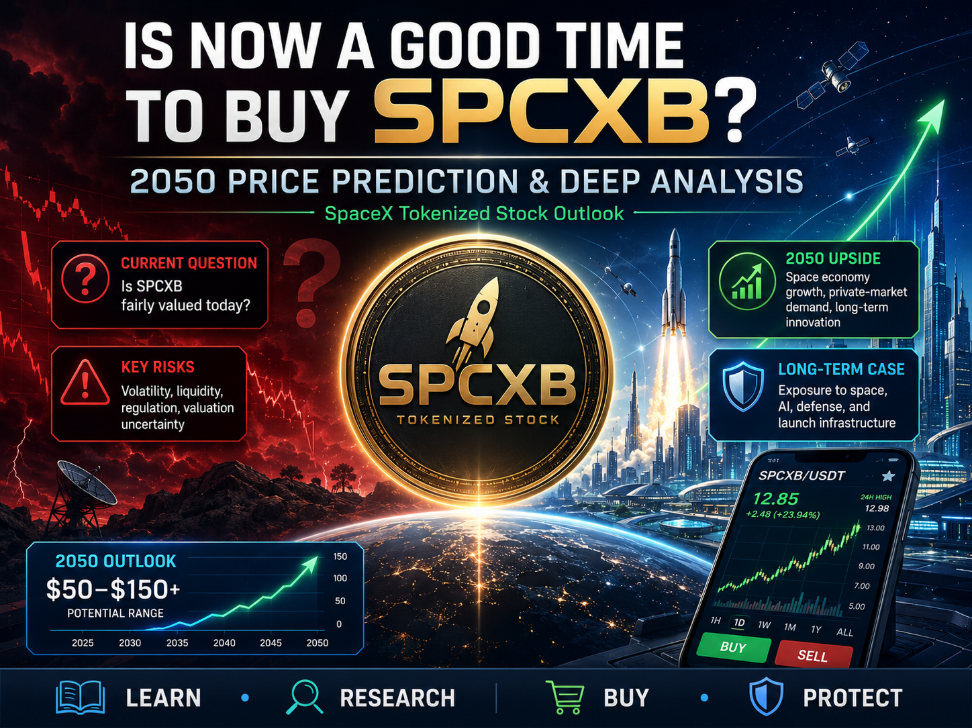
Neither. It has three hybrid characteristics:
- Stock-like: its price tracks SpaceX's (SPCX) performance
- Crypto-asset-like: tradeable on-chain, circulating 24/7
- Structured-product-like: the issuing institution handles the mapping and custody
The key point: what you're buying is "price exposure," not "company equity."
2) Does it come with voting rights or dividend rights?
No. SPCXB holders:
- Do not have SpaceX voting rights
- Do not have shareholder dividend rights
- Cannot participate in company governance
What you get instead:
- Upside if SpaceX's stock price rises
- Corresponding downside if it falls
- On-chain trading liquidity
3) What's the relationship between SPCXB and SPCX on Nasdaq?
SPCX (hypothetically, SpaceX's Nasdaq-listed stock) is the underlying asset.
SPCXB is the mapping layer.
The relationship can be understood as: SPCX (the real stock) → custody → generates a 1:1 pegged SPCXB.
This 1:1 peg means:
- In theory, prices move in perfect sync
- Arbitrage mechanisms can correct deviations
- But under extreme market conditions, a temporary de-peg could occur
4) SPCXB vs. other SpaceX tokenized products
Similar products in the market include SPCXX, RSPCX, and Paimon SPCX.
The key differences:
- SPCXB: part of the Binance bStocks ecosystem, the strongest liquidity
- SPCXX: a smaller issuer, weaker liquidity
- RSPCX: leans toward a European compliance structure
- Paimon SPCX: leans toward a structured fund mapping approach
In simple terms: SPCXB combines the strongest liquidity, Binance ecosystem backing, and the highest trading convenience.
For a comparative understanding of this product category, you can reference the breakdown of TSLAB's tokenized stock mechanism.
II. SpaceX's IPO Background — Why Could This Be the Largest IPO in History?
SPCXB's core value isn't the token — it's the asset behind it: SpaceX.
1) The IPO and valuation: what does $1.77 trillion mean?
Assuming SpaceX goes public in 2026:
- IPO price: $135
- First-day close: $161
- Market cap: $1.77 trillion
This scale would place it in Apple-tier company territory — the top bracket of global tech valuations.
The question is whether that's expensive. For comparison: Amazon's early price-to-sales ratio was roughly 10–20x; Tesla's peak price-to-sales ratio exceeded 100x; SpaceX's hypothetical current ratio is around 94x sales.
The takeaway: this is currently priced as an asset with extremely high embedded expectations.
2) Three core business segments: which one is the real cash engine?
SpaceX's revenue structure primarily comes from three areas.
Starlink (satellite internet): the long-term cash flow core, driven by subscriber growth.
Rocket launch business: a mix of government and commercial contracts, with high margins but significant volatility.
AI / xAI ecosystem synergy: a long-term strategic collaboration business still in its investment phase.
The conclusion for the current stage: Starlink is the cash flow, rockets are the reputation and contract entry point, and AI is the long-term imagination space.
3) Profitability: is the company actually making money?
2025 figures: revenue of $18.67 billion, net loss of $4.94 billion.
What this tells us: the company is still in a phase of aggressive scaling, and the losses stem primarily from R&D spending — Starship development and Starlink expansion.
4) Why is there such a wide divergence in 2030 forecasts?
Three major projections diverge significantly:
- Elon Musk: $1 trillion in revenue
- Goldman Sachs: $470 billion
- Morgan Stanley: $330 billion
The reasons for the divergence: differing assumptions about Starlink's growth model, differing assumptions about how quickly rocket commercialization scales, and whether AI revenue is factored in at all.
5) Bitcoin exposure risk
SpaceX holds approximately 18,712 BTC.
This means SPCXB effectively also carries implicit exposure to BTC as a risk asset.
III. A Deep Dive Into Binance bStocks Mechanics — Is Your Money Actually Safe?
SPCXB belongs to the Binance bStocks product line.
1) Where exactly are the assets held?
The core structure: user funds flow to BTech Holdings Limited; the assets are held in custody by a compliant financial institution; the regulatory framework is ADGM/FSRA.
ADGM/FSRA refers to the Abu Dhabi financial regulatory system — a framework that leans toward institutional-grade oversight, with strict audit and asset segregation requirements.
2) How does the 1:1 conversion mechanism actually work?
The process: a user buys SPCXB; BTech holds the underlying SPCX in the market; hedging and settlement are handled through Nest Trading Limited; the corresponding receipt is generated on-chain.
3) Is there any bankruptcy-related protection?
Important clarifications: this is not bank deposit insurance, and it is not shareholder equity. There is an asset segregation mechanism, and there is a custody structure.
But risk still remains: issuer risk is one of the most significant structural risks inherent to SPCXB.
4) On-chain holding vs. exchange holding
Holding on an exchange is more convenient for trading but depends on the platform's security. Self-custodying on-chain gives you control over your private keys, but requires you to manage the risk yourself.
5) Regional restrictions
US users are prohibited from participating. Some EU countries impose restrictions. Asia and the Middle East are generally open.
For understanding a comparable structural mechanism, you can reference the TSLAB tokenized stock breakdown.
IV. Analyzing SPCXB's Price Drivers
SPCXB's price isn't fundamentally driven by "token-market dynamics." It's driven by SpaceX's fundamentals, market sentiment, and liquidity structure.
1) The core driver: tracking the stock price
SPCXB ≈ SPCX. The influencing factors are SpaceX's business performance, market risk appetite, and macro liquidity conditions.
2) Starlink subscriber growth vs. declining ARPU
There's a built-in tension here: subscriber growth is climbing rapidly, while ARPU (average revenue per user) may decline due to competition and price cuts.
The result: revenue growth doesn't automatically translate into profit growth.
3) Three major catalysts
Starship commercialization (targeted around 2027), expanding defense contracts, and xAI commercialization revenue.
4) The lock-up unlock event (September 2, 2026)
A key event: the first earnings release combined with roughly 7% of shares unlocking from lock-up.
Historical precedent suggests post-IPO unlock events typically bring 10–30% price volatility.
5) Correlation with the crypto market
The mechanism: when BTC rallies, liquidity strengthens and bStocks trading volume rises; when BTC falls, leverage contracts and liquidity discounts widen.
V. SPCXB Price Forecasts: 2026–2050
Forecast baseline: IPO price of $135, current price range of $170–$200.
2026: bear case $90–$120; base case $160–$190; bull case $220–$250
2027: bear case $80–$110; base case $175–$220; bull case $280–$350
2028: bear case $100–$150; base case $200–$280; bull case $350–$450
2029: bear case $130–$180; base case $260–$350; bull case $400–$550
2030: bear case $120–$160; base case $300–$420; bull case $500–$700
The core logic behind each scenario
In the bear case: valuation multiples compress to 20–30x, Starlink growth decelerates, and profits fall short of expectations.
In the base case: a stable profitability model takes shape, Starlink cash flow stabilizes, and institutional allocation increases.
In the bull case: Starship achieves commercial success, xAI revenue surges, and the company approaches a path toward $1 trillion in revenue.
For an extended reference framework on long-term pricing logic, you can also look at the ETH long-term pricing framework.
VI. Five Reasons to Buy SPCXB Now vs. Five Risks
The bull case
SpaceX holds a globally dominant satellite network through Starlink, an unmatched leadership position in the rocket launch market, a relatively mature compliance framework through bStocks, 24/7 global trading access that lets investors participate in IPO-related upside, and potential passive fund inflows from MSCI index inclusion.
The bear case
Current valuation appears to significantly front-run future growth, lock-up unlock pressure is a concrete near-term risk, the structured product is not equivalent to equity ownership, the $1 trillion revenue target is an extremely difficult bar to clear, and crypto market liquidity risk can amplify price volatility.
VII. How to Buy SPCXB on HiBT
The HiBT process:
1) Registration and KYC: register with your phone number or email, complete identity verification (passport or ID card), and complete a risk assessment questionnaire.
2) Deposit funds: using USDT, BTC, or ETH, via on-chain transfer or fiat deposit.
3) Trade SPCXB: search for the SPCXB/USDT pair; use a market order for fast execution, or a limit order to control your entry cost.
4) Manage risk: set a stop-loss (e.g., -10%/-20%), build your position in tranches, and avoid chasing price into the unlock window.
5) Track key events: keep an eye on SpaceX's earnings release (September 2, 2026), Starlink subscriber growth, and Starship's launch success rate.
For an entry-timing reference methodology, you can also look at the Bitcoin entry-timing analysis framework.
VIII. Risks Every SPCXB Investor Must Confront
1) Valuation risk: if revenue only reaches 50% of expectations, the stock could be repriced down by roughly -40% to -70%.
2) Regulatory risk: the legal status of tokenized securities remains unsettled, and various countries could impose restrictions on circulation.
3) Liquidity risk: spreads can widen significantly during extreme market conditions, and timely execution may not be possible.
4) Governance risk: Elon Musk's personal conduct can influence valuation, and social media or political controversy can spill over into the stock's performance.
5) Technical risk: Starship incidents, or Starlink service disruptions.
Disclaimer
Everything in this article is structural analysis and scenario projection only — it does not constitute investment advice of any kind. SPCXB is a highly volatile tokenized securities product, and investors should fully understand the risks before making any decision.
Summary
SPCXB, at its core, is neither a "coin" nor a "stock." It's a tool that financializes and tokenizes SpaceX's future value into a tradeable price exposure instrument.
Its investment logic boils down to a single sentence: if you believe in SpaceX's future, you'll be bullish on SPCXB; if you don't believe in SpaceX's long-term growth, you should approach it with caution.
But the fundamental question never changes: what you're buying isn't today's SpaceX — it's a discounted bet on the SpaceX of 2050.